

Image by Michael Kappel via Flickr
By Arun Gupta
With the forcible closure of major occupations across the country through a combination of police repression and official disinformation, the movement is at a crossroads.
Image by Michael Kappel via Flickr
By Arun Gupta
With the forcible closure of major occupations across the country through a combination of police repression and official disinformation, the movement is at a crossroads.
Filed under Occupy Movement
BY ARUN GUPTA

Occupy protesters on the Capitol steps in Boise, Idaho. (Credit: AP/Jessie L. Bonner)
TOPICS: OCCUPY WALL STREET, OCCUPY BOISE, OCCUPY MOVEMENT
BOISE, Idaho — One talked, the other snickered. The talker wore a red Harley-Davidson jacket and a salt-and-pepper poof of hair and drooping mustache. ” While the snickerer watched, the talker harangued Jon Howard, a “marginally employed” stagehand, about whether the Boise occupation was legal, and Jon said it was. The talker wanted to know whether they were paying for the electricity they were using on the grounds of the old Ada County Courthouse, and Jon said they were. A moment earlier I had sensed the tension and bounded over, looking for a reason to escape the wild-eyed “home-church” Christian pastor I had made the mistake of engaging.
It didn’t take long for the talker to get a look at me and launch into an “all you left-wing supporters of Obama” monologue. I mentioned I was an out-of-town observer and asked if he was with the Tea Party.
“I’m a conservative. And an American,” he said.
Filed under Occupy Movement
Michelle Fawcett and Arun Gupta describe some of the insights and experiences travelling across the country to visit occupation sites with Mary-Charlotte Domandi of Santa Fe Radio Cafe.
Listen: http://www.santaferadiocafe.org/podcasts/?p=1688
Filed under Occupy Movement
Excerpts from a talk by Arun Gupta in Marfa, Texas where he discusses the Occupy Movement, his experiences meeting occupiers during his and Michelle Fawcett’s travels, the Democratic party, and the potential of the movement. Video produced by Michelle Fawcett.
Filed under Occupy Movement

guardian.co.uk, Wednesday 30 November 2011
Sitting in a car parked at a gas station on the outskirts of Houston, Texas, my colleague Michelle holds an audio recorder to my cellphone. At the other end of the line is Arundhati Roy, author of the Booker Prize-winning The God of Small Things, who is some 2,000 miles away, driving to Boston.
“This is uniquely American,” I remark to Roy about interviewing her while both in cars but thousands of miles apart. Having driven some 7,000 miles and visited 23 cities (and counting) in reporting on the Occupy movement, it’s become apparent that the US is essentially an oil-based economy in which we shuttle goods we no longer make around a continental land mass, creating poverty-level dead-end jobs in the service sector.
This is the secret behind the Occupy Wall Street movement that Roy visited before the police crackdowns started. Sure, ending pervasive corporate control of the political system is on the lips of almost every occupier we meet. But this is nothing new. What’s different is most Americans now live in poverty, on the edge, or fear a descent into the abyss. It’s why a majority (at least of those who have an opinion) still support Occupy Wall Street even after weeks of disinformation and repression.
In this exclusive interview for the Guardian, Roy offers her thoughts on Occupy Wall Street, the role of the imagination, reclaiming language, and what is next for a movement that has reshaped America’s political discourse and seized the world’s attention.
Filed under Economy, Occupy Movement
Occupation activists speak about what their vision for the economy and the movement is in Michelle Fawcett’s video.
Filed under Occupy Movement

Occupy Charleston, WV
Occupy Charleston, WV
AUSTIN, Texas — Under a photovoltaic glass trellis, on the terraced steps of Austin’s modernist City Hall, dozens of occupiers sprawl amid sleeping bags and sleeping dogs. A few people tap on computers while others nestled in bedding sit up, looking as if they are slowly sloughing off a hangover. It’s about 4 in the afternoon.
Trying to escape the pungence of fermenting compost, I gingerly climb the steps, scooting around one young woman with a brown sweater knotted around her waist and blue jeans around her ankles. A few feet away, a wiry guy in a flower-print sundress with body hair spilling out like Borat in a mankini strums a guitar.
At a table that passes for the kitchen on the plaza below a hefty man with a bandanna hanging off his chin eagerly offers mashed beans and vegetables on bread to passersby. A dozen homeless youth pass around a bowl as three impassive cops hang on the edge of the occupation. Two older women waltz to music only they can hear and a shirtless man grabs his shorts with one hand and a protest sign with the other as he chases a death-defying dog across four lanes of traffic.
When I describe the scene to Michelle Millette, an organizer with Occupy Austin, she laughs and in a rising voice says, “Keep Austin weird!” She explains that the encampment, which is mostly street people, stems from the fact that “Austin has a huge homeless population. A lot of the people are there because they say, ‘This is the only place I can legally sleep because I’ve been chased out of everyplace else.’” Plus, Millette adds, because the city has banned tents, “it looks like a hobo camp to people walking by. Many people are afraid to leave their stuff because it’s just lying out there.”
Filed under Economy, Occupy Movement

Occupy Chicago has not held any public space since mass arrests on Oct. 23. (Credit: AP/Paul Beaty)
The post-occupation movement is taking shape across America. In New York, Occupy Wall Street is mulling next steps now that Zuccotti Park has been politically cleansed. Oakland, Calif., and Portland, Ore., have been evicted. And other occupations are staring at imminent police action, including New Orleans, Detroit and Philadelphia.
In Chicago, which has been unable to secure a public space, the Occupy movement is trying to figure out how to sustain a public presence through a harsh winter while staging creative actions that capture attention. And while Occupy Mobile in the conservative stronghold of Alabama was shut down two weeks ago without much attention from the national news media, the local movement has not gone quietly into the night, providing one answer to the question: Can an occupation movement survive if it no longer occupies a space?
The answer, based on my visits to occupation sites around the country, is: “Yes, but …”
Filed under Occupy Movement
There may be few parallels in U.S. history to the occupy movement that has spread to hundreds of cities and towns in the last two months, but the causes are a familiar story: a gilded elite who monopolize power and wealth against a public who feel they have no say in the system and no control over their lives.
This divide is encapsulated by the “There is tremendous suffering” refrain I have heard at occupations from New York to New Orleans and Washington, D.C. toDetroit.
Filed under Occupy Movement
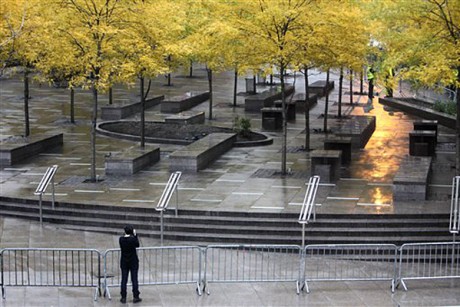
A pedestrian takes a picture of an empty and closed Zuccotti Park in New York, Nov. 15, 2011. (Credit: AP/Seth Wenig)
Topics: Occupy Wall Street
Right now in executive suites, political chambers and police command centers the 1 percent are cheering. They are slapping backs, grinning from ear to ear and bursting with delight. Messages of “congratulations” and “job well done” from the wealthy are surely flooding the offices of their political pets and police enforcers.
Why shouldn’t they celebrate? For 30 years they have ruled as masters of the universe, while we toil as their serfs. As long as politicians comforted the owning class with bailouts and tax cuts, and the corporate media cheered rising stock prices and record corporate profits, the 1 percent knew their house was in order.
Filed under Occupy Movement

 Arun K. Gupta