
Occupation activists speak about what their vision for the economy and the movement is in Michelle Fawcett’s video.
Occupation activists speak about what their vision for the economy and the movement is in Michelle Fawcett’s video.
Filed under Occupy Movement

Occupy Charleston, WV
Occupy Charleston, WV
AUSTIN, Texas — Under a photovoltaic glass trellis, on the terraced steps of Austin’s modernist City Hall, dozens of occupiers sprawl amid sleeping bags and sleeping dogs. A few people tap on computers while others nestled in bedding sit up, looking as if they are slowly sloughing off a hangover. It’s about 4 in the afternoon.
Trying to escape the pungence of fermenting compost, I gingerly climb the steps, scooting around one young woman with a brown sweater knotted around her waist and blue jeans around her ankles. A few feet away, a wiry guy in a flower-print sundress with body hair spilling out like Borat in a mankini strums a guitar.
At a table that passes for the kitchen on the plaza below a hefty man with a bandanna hanging off his chin eagerly offers mashed beans and vegetables on bread to passersby. A dozen homeless youth pass around a bowl as three impassive cops hang on the edge of the occupation. Two older women waltz to music only they can hear and a shirtless man grabs his shorts with one hand and a protest sign with the other as he chases a death-defying dog across four lanes of traffic.
When I describe the scene to Michelle Millette, an organizer with Occupy Austin, she laughs and in a rising voice says, “Keep Austin weird!” She explains that the encampment, which is mostly street people, stems from the fact that “Austin has a huge homeless population. A lot of the people are there because they say, ‘This is the only place I can legally sleep because I’ve been chased out of everyplace else.’” Plus, Millette adds, because the city has banned tents, “it looks like a hobo camp to people walking by. Many people are afraid to leave their stuff because it’s just lying out there.”
Filed under Economy, Occupy Movement

Occupy Chicago has not held any public space since mass arrests on Oct. 23. (Credit: AP/Paul Beaty)
The post-occupation movement is taking shape across America. In New York, Occupy Wall Street is mulling next steps now that Zuccotti Park has been politically cleansed. Oakland, Calif., and Portland, Ore., have been evicted. And other occupations are staring at imminent police action, including New Orleans, Detroit and Philadelphia.
In Chicago, which has been unable to secure a public space, the Occupy movement is trying to figure out how to sustain a public presence through a harsh winter while staging creative actions that capture attention. And while Occupy Mobile in the conservative stronghold of Alabama was shut down two weeks ago without much attention from the national news media, the local movement has not gone quietly into the night, providing one answer to the question: Can an occupation movement survive if it no longer occupies a space?
The answer, based on my visits to occupation sites around the country, is: “Yes, but …”
Filed under Occupy Movement
There may be few parallels in U.S. history to the occupy movement that has spread to hundreds of cities and towns in the last two months, but the causes are a familiar story: a gilded elite who monopolize power and wealth against a public who feel they have no say in the system and no control over their lives.
This divide is encapsulated by the “There is tremendous suffering” refrain I have heard at occupations from New York to New Orleans and Washington, D.C. toDetroit.
Filed under Occupy Movement
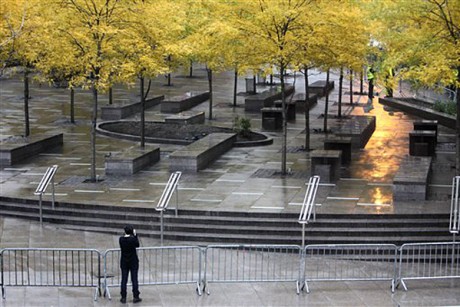
A pedestrian takes a picture of an empty and closed Zuccotti Park in New York, Nov. 15, 2011. (Credit: AP/Seth Wenig)
Topics: Occupy Wall Street
Right now in executive suites, political chambers and police command centers the 1 percent are cheering. They are slapping backs, grinning from ear to ear and bursting with delight. Messages of “congratulations” and “job well done” from the wealthy are surely flooding the offices of their political pets and police enforcers.
Why shouldn’t they celebrate? For 30 years they have ruled as masters of the universe, while we toil as their serfs. As long as politicians comforted the owning class with bailouts and tax cuts, and the corporate media cheered rising stock prices and record corporate profits, the 1 percent knew their house was in order.
Filed under Occupy Movement

Photo Credit: edenpictures on Flickr
By Arun Gupta
Political occupations have a storied history starting with the first recorded labor strike. Some 3,176 years ago in Ancient Egypt royal tomb builders from the desert village of Deir el-Medina repeatedly occupied temples following the failure of Pharaoh Ramses III to provide wages consisting of wheat, fish, beer, clothing and other provisions.
In the centuries since, other movements have stamped their mark on history by occupying spaces, such as the Diggers who formed a utopian agrarian community on common land in 17th century England, and the workers, soldiers and citizens who established the ill-fated Paris Commune in 1871.
American history is rich with examples of political occupations that left a lasting impact. Sometimes the 99% pushed progress forward, as with Rosa Park’s occupation of a bus seat that propelled the Montgomery Bus Boycott and ended with Alabama’s bus segregation being declared unconstitutional. Often the 1% of the time – slaveholders, robber barons and merchants of war – re-asserted control with new methods of domination such as after the Great Upheaval of 1877. But each event proved that true democracy lies in collective act of taking space public and private, while corporations and the state are just two arms of the same beast.
With the spread of political occupations to all 50 states today, the most dynamic democratic movement since the 1960s, lessons can be gleaned from past occupations for a movement that shows no signs of going away. Here are seven of the most important occupations that changed American history.
Filed under Occupy Movement
BY ARUN GUPTA

Occupy Wall Street protesters during a rally in Chicago (Credit: AP/Charles Rex Arbogast)
There is some truth to the contention that the nationwide Occupy Wall Street is largely a white-led movement, as indicated in a recent Maynard Institute article by Nadra Kareem Nittle. But claiming there are “few people of color among the participants,” as Nittle does, is simply not true.
I say that as someone who was present when the Occupy Wall Street began in New York on Sept. 17 and who has visited 15 occupation sites around the country. I was at Zuccotti Park almost every day for the first three weeks of the occupation and I saw it transition from a movement almost exclusively of white youth to a broad left movement to a multiracial movement and finally to something that represents the composition of this country more accurately than almost any other social phenomenon we can imagine.
Filed under Occupy Movement
Michelle Fawcett’s video lets participants in the Occupation movement in Allentown, PA describe why they protest.
Filed under Occupy Movement

We’ve hit 14 occupations thus far. The latest ones being Charleston and Huntington, West Virginia, and Lexington, Kentucky. One common refrain is “the American Dream” is no longer possible, it’s dead or it’s a nightmare. The American Dream is shorthand for the middle class utopia. It’s the post-WWII ideal of well-paying working class jobs that can support a family, which have full benefits, and hope that the next generation will be better educated, have more opportunities and greater prosperity.
It’s a powerful mythology that ignores how socially deadening post-war society was. It was based on American Apartheid, virulent anti-Communism and suffocating notions of sexuality. Poverty was still widespread at home, Cold War militarism and the rise of advertising boosted the economy and plunder from the underdeveloped world allowed for increasing standards of living at home.
In the following article published before the occupy movement began I argue against the idea that “saving” the middle class should be the center of political or social struggles. Now, this is highly relevant to the Occupy movement because many people we have interviewed think we can just return to this post-war fantasy with a few policy tweaks and an election or two.
Just as the current crisis festered over many decades and is thus deeply rooted in our socio-economic system, creating a new world means radically restructuring our society and social relations, something that is not going to happen overnight or by electing some Democrats.
Filed under Economy, Occupy Movement, Politics
Interview with Arun Gupta, a founding editor of New York City’s Indypendent newspaper, conducted by Scott Harris for the nationally syndicated radio show “Between the Lines.”
Full-length Counterpoint interview (20:14):
Filed under Occupy Movement

 MP3
MP3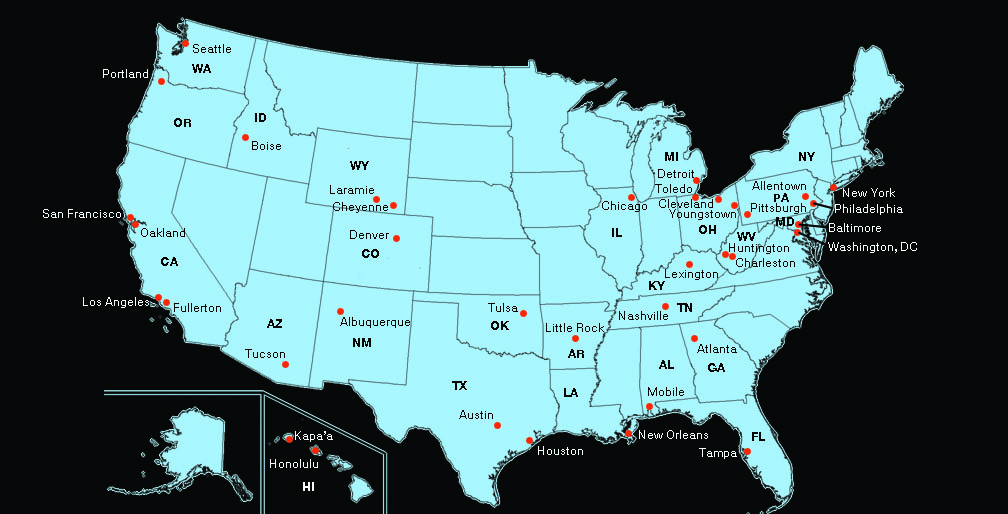

 Arun K. Gupta