Tag Archives: Occupy Wall Street

Occupying the Unexpected (The Nation)

Photos of Occupy Wall Street on Day 20, Octobe...

Photos of Occupy Wall Street on Day 20, October 5, the day of the big march with unions in solidarity with OWS. (Photo credit: Wikipedia)

March 14, 2012

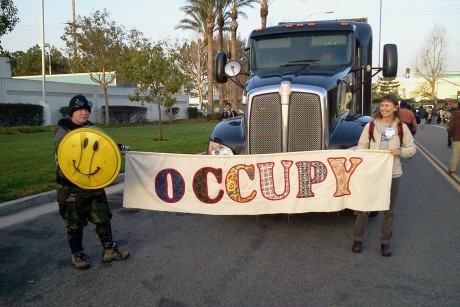
The few remaining occupations aren’t easy to find, but visiting one reminds you why Occupy set the imagination on fire. At a late-February “Occupalooza” organized by Occupy Fullerton in Orange County, we talked with Wolf, a 25-year-old transgendered activist, who explained how the group is lobbying the City Council to pass resolutions on issues ranging from Citizens United to predatory debt. We also met John Park, a Korean-American with two kids in college, who launched into a blistering critique of the ideology of free trade. That Wolf has found common cause with a middle-aged immigrant computer programmer speaks to the raw ideological and emotional power of the twinned slogans—“We are the 99 percent” and “Occupy Wall Street.”

At Occupy’s encampments, anyone could walk into the public space, share his or her story, find people with similar grievances and participate in building mini-societies. Creating democratic town squares next to centers of power drew in huge numbers of people who gave the movement life. First-time activists didn’t need to arrive having mastered volumes of social and cultural theory, and they weren’t treated to the same old canned chants and pre-printed signs. The movement didn’t require consultants, focus groups or polls to occupy the center of American politics with a radical left message. As such, Occupy wasn’t just a rejection of Washington and Wall Street; it revealed the failings of liberals, unions and the organized left.
Continue reading

7 Comments

Filed under Occupy Movement

Occupy invades “America’s storage shed” (Salon)

Faced with protest, Walmart unilaterally shuts down three warehouses in Southern California

TOPICS: 

Spilling out below the snow-dusted San Bernardino Mountains, California’s Inland Empire in Southern California is America’s storage shed. Its economy is a key link in the global supply chain. Goods from Asia funnel through the Los Angeles and Long Beach ports that handle more than one-quarter of all the imports pouring into the United States every year, and much of it is warehoused here before finding its way into homes and businesses across the nation. If all the storage space was gathered under one roof, more than 700 million square feet, it would make a warehouse larger than Manhattan.

With manufacturing scant in the Inland Empire, an estimated 118,000 workers are employed hustling through cavernous warehouses to stack and fetch goods or hauling them in rigs. The area is infested with banal exurbs that clump in towns such as Mira Loma, which has been tagged the “diesel death zone” for the lung-searing truck pollution that envelops it. It was in Mira Loma that a few hundred members of various Southern California Occupy movements converged at sunrise  on Feb. 29 with the goal of shutting down a Walmart distribution center.

Continue reading

Leave a comment

Filed under Economy, Occupy Movement

To camp or not to camp? That is Occupy’s question (Salon)

Occupy Tampa protest Oct 2011

Occupy Tampa protest Oct 2011 (Photo credit: Sasha Rae Photo - Shanna Gillette)

After a wave of shutdowns, about 20 Occupy camps still stand. What do they tell us about the state of the movement?

Occupy Tampa has had a rough life. Born on a “Day of Rage” that drew 1,000 people to Tampa, Fla.’s downtown on Oct. 6, it put down roots three days later on a public sidewalk bordering Curtis Hixon Park. It soon blossomed into a community of more than 100 residents adorned with tents, medics, media, kitchen and library on a concrete patch less than 10 feet wide.

From day one, the Tampa police were a fixture in their lives. “They would come by at 6 a.m. to wake us up, and again in the afternoon to make us move our belongings off the sidewalk,” says Samantha Bowden, a 23-year-old senior at the University of South Florida. The occupiers taped off a 6-foot section of the sidewalk for egress and say the city conceded it had the right to a 24-hour presence, but the police were intent on retarding the occupation’s development by wielding a code against leaving articles on the sidewalk. Occupy Tampa occupiers adapted by placing their belongings on carts so they could be wheeled away whenever the police descended.

Continue reading

Leave a comment

Filed under Occupy Movement

Occupy’s challenge: Reinventing democracy (Salon)

Behind the scenes with rogue drummers, homeless, liberals and the black bloc as OWS grapples with self-government

Occupy Wall Street protesters demonstrate on Capitol Hill in Washington on Jan. 17. (Credit: AP/J. Scott Applewhite)

The panicked emails and texts sounded like a prank worthy of the Yes Men. Occupy Wall Street — which like some comic book character only grew stronger after each attack by nefarious forces, whether pepper spray, mass arrests or New York mayor Michael Bloomberg’s threat to close the park for cleaning – had finally been brought to its knees.

What was about to kill the most successful American activist movement in decades? The drum circle.

Drummers possessed with a Dionysian fervor were demanding that they be allowed to pound their bongos and congas late into the night because they were the “heartbeat of this movement.” In response, a letter circulated with the dramatic warning that “OWS is over after Tuesday.” With equal doses of Middle East diplomacy and Burning Man theatrics, the writer explained that weeks of negotiations between a drummers’ working group called Pulse, the OWS General Assembly and the local community board had collapsed.

Continue reading

2 Comments

Filed under Occupy Movement

Occupy fights the law: Will the law win? (Salon)

From Boise to Nashville, the movement faces an unconstitutional legal siege

Occupy Boise is under legal and meteorological siege. (Credit: AP/John Miller)

The Occupy movement is an exercise in the workings of power whether it is social, financial, policing or political. The occupations that began in September spread with an infectious passion in part because the police violence and mass arrests, the tried-and-true methods of state power employed to suppress radical movements, backfired and the movement grew more. By October hundreds of encampments had popped up nationwide with the tacit cooperation and sometimes explicit approval of local officials. For a few heady weeks Occupy Wall Street had the glow of popular legitimacy – social power – trumping whatever fusty laws prohibited camping or a continuous presence in a public space.

The inevitable counteroffensive was launched in November. Using the mass media, politicians hyped the movements as imminent threats to public health and safety, justifying aggressive evictions of prominent occupations in Oakland, Calif., Portland, Ore., and New York City. Within weeks other major encampments in Los Angeles, Seattle, Boston and New Orleans were scattered with hundreds of arrests. A third wave of closures has been underway since late January with occupations shut down from Hawaii to Miami and Austin, Texas, to Buffalo, N.Y.

Nonetheless, some encampments survive. In Houston a small contingent is legally maintaining a presence in downtown Tranquility Park, though a ban on tents and tarps has kept all but the hardy or desperate away. In Tampa Bay, after months of police harassment, occupiers found a safe haven in a privately owned public space donated by a wealthy supporter.

Now, a new strategy is being deployed to yank the rug from under occupations in four cities: legal power. Politicians have recently passed laws in Honolulu and Charlotte, N.C., that with a stroke of the pen made the occupations illegal, enabling police to sweep them away. Two more occupations, in Boise, Idaho, and Nashville, may be nearing the end as their respective state legislatures are on the verge of outlawing the democratic villages that for months have been thriving next to edifices of power. Critics charge that the anti-Occupy laws reveal how the law is not an objective code that treats everyone equally, but an arbitrary weapon wielded by the powerful.

Continue reading

1 Comment

Filed under Occupy Movement

Arun Gupta comments for The Atlantic on Occupying the ‘Wall Street Journal’

Occupying the ‘Wall Street Journal

By Susie Cagle

The protest movement is appropriating the names and logos of corporate-owned publications. Is it copyright infringement or satire?

Courtesy of Scott Johnson

excerpts:

“I think it is great how it became a meme so quickly,” says Arun Gupta, one of the founders of The Occupied Wall Street Journal. “Like many other aspects of Occupy Wall Street, this idea just spread rapidly across the country.” The Occupied Wall Street Journal, a project originally put together by Gupta and a collective of other Occupy Wall Street activists, raised more than $75,000 in a Kickstarter campaign.

“It’s direct action — another form of occupying,” says Gupta of the newspapers — physical protest objects, and historic artifacts. “They make the movement real in a way digital media never can.”

To Gupta’s knowledge, The Occupied Wall Street Journal hasn’t received any complaint — or praise — from the original Wall Street Journal. “In fact, all the media reports would actually say the WSJ declined to comment,” says Gupta.

[snip]

“This is why I say it’s political,” says Gupta. “Occupy Wall Street had such a huge kind of ideological and political presence that to go after them this way actually validates everything the movement is talking about: that the 1% is trying to use their power and wealth against the 99%.”

“Because they’re on such weak legal ground, to bring suit would come across as a case of bullying. They have nothing to gain from it,” says Gupta. “I think, though, when you get into other cities, people freak out when they’re being approached by lawyers with intimations of legal action.”

[snip]

The full article available online at:

http://www.theatlantic.com/national/archive/2012/02/occupying-the-wall-street-journal/252601/

1 Comment

Filed under Occupy Movement

What Occupy taught the unions (Salon)

SEIU and others are embracing the movement that has succeeded as they have faded

Unions and Occupy: who's leading who?

Topics: ,

Unions are in a death spiral. Private sector unionism has all but vanished, accounting for a measly 6.9 percent of the workforce. Public sector workers are being hammered by government cutbacks and hostile media that blame teachers, nurses and firefighters for budget crises. To counter this trend organized labor banked on creating more hospitable organizing conditions by contributing hundreds of millions of dollars to the Democratic Party the last two election cycles. In return Obama abandoned the Employee Free Choice Act, which would have made union campaigns marginally easier, failed to push for an increase in the minimum wage, and installed an education secretary who attacks teachers and public education.

The Obama administration’s dismal record on labor issues has been compounded by the rise of the Tea Party movement, which portrays unions as public enemy No. 1, and the Supreme Court’s Citizens United decision, which opened the political floodgates to corporate money. By last year, organized labor realized that its days were numbered unless it took a different approach.

So it went back to basics. Across the country unions threw resources into community organizing, aiming to build a broad-based constituency outside of the workplace for progressive politics. In cities like Chicago, Philadelphia and Portland, Ore., newly formed community groups found ready support for organizing around issues of economic justice, but they were stymied by a national debate dominated by voices blaming government spending for an economic crisis caused by Wall Street.

Occupy Wall Street changed that. It flipped the debate from austerity to inequality, uncorked a wellspring of creative energy and started taking creative risks that unions typically shun. Within weeks unions adopted the 99 percent versus the 1 percent and started organizing actions under the Occupy banner. One labor leader said “the Occupy movement has changed unions’” messaging and ability to mobilize members. Union-affiliated organizers around the country say it has helped workers win better contracts and bolstered labor reformers.

Continue reading

2 Comments

Filed under Occupy Movement

Inside the Occupy Movement

Arun Gupta and Michelle Fawcett’s description of  their visits to nearly thirty occupations in twenty states in two months is in the latest issue of The Progressive. Please buy the latest issue to read the story.

Leave a comment

Filed under Occupy Movement

Occupying Hawaii: Paradise Lost and Found (Truthout)

Kauai, the "Garden Island"

Kauai, the “Garden Island.” (Photo: yark64)

Sunday 29 January 2012

by: Michelle Fawcett, Truthout | News Analysis

Ever since the Garden of Eden headlined the Torah, savvy marketers have realized that we all deeply desire a slice of paradise. Utopia is woven into America’s national fabric starting with the Puritan ideal of a “city upon a hill” and progressing through the centuries to Shakers, Mormons, Manifest Destiny, socialists and suburbia. These days, paradise is all around us from potato chips seasoned with “harmonic convergence” to bath soaps that “take me away” to Steve Jobs’ “quest for perfection.”

Utopia has always been half the equation, however, the balance being the extermination of indigenous people, who already inhabited the land, and denial of entry for all manner of people from blacks and women to immigrants and the poor.

This dichotomy is evident in Hawaii where competing visions of paradise blend with dystopian realities. Now, Hawaii would soften even a cynic’s heart. I’ve been visiting Kauai, the “Garden Island,” for 20 years and remain intoxicated by the undulating emerald mountains of the Na Pali Coast, the warm, aquamarine waters of Hanalei Bay and the “Aloha spirit” of its people.

The natural splendor of Hawaii draws about seven million tourists a year as well as thousands of transplants, many wealthy, who relocate to the Pacific island chain for the relentlessly balmy weather. At the same time, the tropical Shangri-La barely conceals teeming tent cities, droves of poverty-wage workers and the legacy of the conquest of native Hawaiians.

Continue reading

1 Comment

Filed under Economy, Occupy Movement

Fear & Occupation in Red America

Leave a comment

Filed under Occupy Movement