
The Homeless and the Occupy Movement
Michelle Fawcett interviews Occupy organizers and the homeless during her and Arun Gupta’s tour of Occupy protests around the U.S.
This was first posted at Salon.com.
Michelle Fawcett interviews Occupy organizers and the homeless during her and Arun Gupta’s tour of Occupy protests around the U.S.
This was first posted at Salon.com.
Filed under Occupy Movement

Two protesters who identify themselves as homeless, at Occupy Providence in downtown Providence, R.I. (Credit: Stew Milne/AP)
Topics:Occupy Wall Street, homelessness
Tevin Bell is 18 but looks twice his age. Kicked out of his grandmother’s home last year after getting into a fight with his younger sister, Bell has been living on the streets of Detroit, “going from shelter to shelter.” On a brisk October afternoon he is relaxing in a folding chair, snug under a heavy jacket, watching flames lick the lip of a rusted barrel stuffed with burning scrap wood.
He is one of dozens of apparently homeless people clustered around Grand Circus Park, site of Occupy Detroit, which began on Oct. 14. Bell arrived two weeks later and has just spent his first night camping. He says, “I got a tent and a blanket. They said I can stay, ‘but you can’t just camp, you gotta help out.’”
Filed under Economy, Occupy Movement
After reporting for Salon from the occupation sites in three Rust Belt cities suffering from serious post-industrial malaise. Michelle Fawcett and I sent this video, which documents the efforts of one such protest movement, in Youngstown, Ohio.
from Visualizing the Rust Belt occupation – Occupy Wall Street – Salon.com.
Filed under Occupy Movement
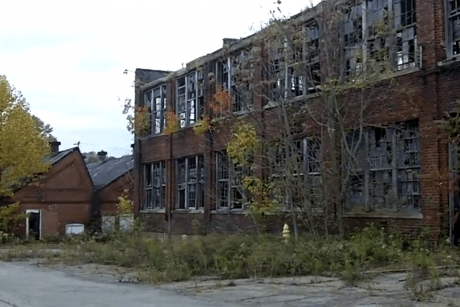
An abandoned building in Youngstown, Ohio
TOPICS: OCCUPY WALL STREET
The surefire method to find occupations in small cities is to head for the center of town. After leaving Philadelphia on our Occupy America tour, we drive an hour north to Allentown. Pennsylvania’s third-largest city at 118,000 residents, Allentown has been weathered by years of deindustrialization in the steel, cement and textile industries that once made it an economic powerhouse.
Along MacArthur Boulevard, one of Allentown’s main drags, tidy but weary brick row homes line outlying neighborhoods. Close to Center Square, site of the requisite Civil War monument, the neighborhoods are heavily Latino and buildings exhibit signs of disrepair.
Filed under Occupy Movement
Published on Monday, October 10, 2011 by The New York Times
At the Occupy Wall Street demonstration in Zuccotti Park, you’ll find all of the essentials of a state-of-the-art protest: drum circles, cheeky and plaintive handwritten signs, and, next to a thrumming generator, a hub of social media activity, including live streaming of the proceedings.The Occupied Wall Street Journal,”a four-page, full-color broadsheet newspaper, has gained surprising traction as a tool of protest at the Occupy Wall Street rallies in Manhattan.
 But amid the accouterments of modern political action, you will also find, of all things, a broadsheet newspaper, The Occupied Wall Street Journal. It is not some tatty, hand-drawn piece of protest samizdat, but a professionally produced, four-color, four-page document of the demonstration, which began on Sept. 17.
“Get your newspaper, get your free Occupied Wall Street Journal!” shouted one barker. Getting something in the hands of your average New Yorker is a pretty tough sell, but The Occupied Wall Street Journal was eagerly received, even by the people who just came to gawk, in part because it answered the question of what all the hubbub was about.
Forgive an old newspaper hack a moment of sentimentality, but it is somehow reassuring that a newspaper still has traction in an environment preoccupied by social media. It makes sense when you think about it: newspapers convey a sense of place, of actually being there, that digital media can’t. When is the last time somebody handed you a Web site?
Filed under Occupy Movement
FRIDAY, OCT 21, 2011 8:00 AM EDT

One month into the Occupy Wall Street protests, many are asking if this new movement is just a “left-wing Tea Party.”
Definitely not. This is not a party, like the Tea Party, that seeks to directly shape the policy and electoral process. Because it is explicitly leaderless, it is difficult to imagine a Michele Bachmann or Eric Cantor emerging as a standard bearer of the Occupy Wall Street movement. Given their reliance on Wall Street money, as well as radical demands from many protesters, the Democrats will find it almost impossible to channel “the 99%” into an electoral tidal wave next year, the way the Republicans rode the Tea Party to victory in 2010.
But that does not mean comparisons to the Tea Party should be dismissed. There are striking parallels between the two movements when viewed through the lenses of politics, society and history.
Filed under Occupy Movement
October 24, 2011
 On Monday night, The New Yorker’s editor, David Remnick, moderated a discussion on the Occupy Wall Street protests, featuring the staff writers John Cassidy and Jill Lepore, along with Arun Gupta (The Indypendent), Priscilla Grim (The Occupied Wall Street Journal), and former Governor Eliot Spitzer.
Vodpod videos no longer available.
The Big Story: Wall Street vs. Main Street Rea…, posted with vodpod
Filed under Occupy Movement
An episode of Al Jazeera‘s Listening Post in which I discuss the media coverage of the Occupy Wall Street movement.
Filed under Occupy Movement
October 14, 2011
by Arun Gupta
Co-founder of The Indypendent and The Occupied Wall Street Journal
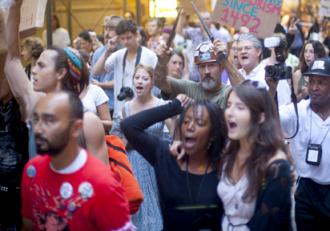
Wall Street occupiers march on Columbus Day
PERHAPS THE most wondrous aspect of the growing Occupy Wall Street movement is that there are lessons for everyone. For the 99 percent, it’s that we still have agency, power and imagination. For the ruling 1 percent, you can’t throw people into despair and deprivation and not expect a social explosion. For the mainstream media, you can’t fit genuine democracy into five-second sound bites or look for anointed leaders. For the right, you can’t cheer revolts and uprisings one minute and condemn them the next.
Filed under Occupy Movement

Here is the recent interview I did with the Canadian Broadcasting Corporation talking about the Wall Street protests and The Occupied Wall Street Journal.
via http://ca.finance.yahoo.com/video/marketnews-24080783/#video=26864766
Filed under Occupy Movement
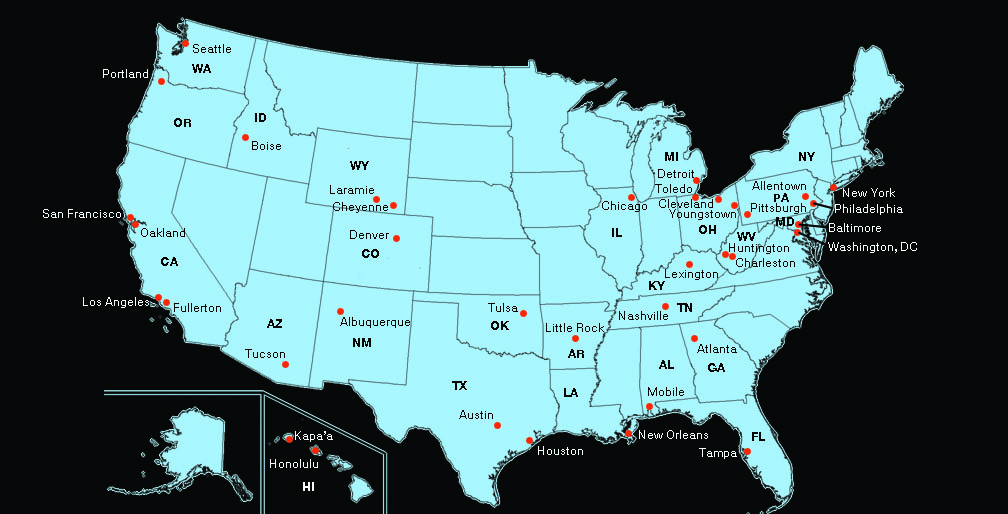

 Arun K. Gupta