CREDIT: Marlena Buczek Smith
There is one simple truth about the discussion of the looming U.S. debt crisis: it is largely a compendium of half-truths, distortions, myths and outright lies.For example, is it true that the U.S. debt unsustainable, which is spurring the budget-cutting fever? Far from it. While U.S. debt is at one of its highest levels ever in terms of gross domestic product, the interest payments in 2011 on the $14.3 trillion public debt will be a mere $386 billion. This is barely more than the $364 billion paid way back in 1998. In real terms, the U.S. economy has grown nearly 30 percent since then. Rock-bottom interest rates on U.S. government debt account for the low payments today, but the practical effect is that servicing the debt as a percentage of
GDP is the lowest it’s been in decades.
Or what about hysterical headlines like “U.S. Debt Default Looms” (courtesy of NPR) unless Democrats and Republicans agree to raise the debt ceiling? They are completely untrue. Richard Wolff, professor of economics emeritus at the University of Massachusetts, Amherst, says, if there is no agreement by Aug. 2 to allow the U.S. Treasury to borrow more funds, then “the government instead would choose among cutbacks on various expenditures such as state and local aid, medical aid, for war, for infrastructure. It would extraordinarily unusual for a government in such a situation to attack its creditors.”
HAPPY CREDITORS
If no deal on the debt ceiling is reached this sucks for the rest of us, such as the millions depending on their portion of the $23 billion in Social Security payments scheduled for Aug. 3. But the creditors will be kept happy and there will be no default because that is how government works in a capitalist economy. And even if the impasse dragged on, the feds could dip into $550 billion in reserves, including more than $400 billion in gold at current prices, to keep making debt payments.
One blatant lie is that Republicans and Democrats, the Congress and the White House are serious about reining in budget deficits to reduce the long-term debt. They are not. The Congressional Budget Office calculates that the deficit from 2011 to 2013 will be $3.5 trillion. Over the next decade it will be $8.5 trillion. Now, lots of numbers are being thrown about on spending cuts over a 10-year period, but they keep dropping — the Senate Democrats are currently proposing $2.2 trillion in cuts and costs savings while the House Republicans weigh in at $915 billion.
Cutting one or two hundred billion dollars a year is meaningless. Wolff says, “Even if you cut the debt $300 billion, you are left with an enormous annual deficit that adds hugely to the national debt they all claim to care so much about. It gives lie to the idea that the Republicans and Democrats are interested in trying to cut the national debt.”
Of course, the stand-off is based on another lie: that Congress and Obama administration can enforce cuts over a 10-year period. The budget process is an annual exercise. There is no provision whatsoever to make cuts permanent because they can always be undone by Congress, and taxes can always be lowered or costly new wars started, both of which always seem to happen, widening the deficit once more.
There is no end to the falsehoods and fantasies from the chattering classes. “We are in recovery.” So says Ben Bernanke — since 2009 no less. Obama has been saying the same since 2010, while hedging that it is “painfully slow.” Really? Tell that to the 25 million Americans who are unemployed, underemployed or have dropped out of the labor force. This amounts to an unemployment rate of 16.2 percent, but the real rate is probably closer to 20 percent after factoring in youth unable to enter the workforce or those who have taken early retirement. Try telling the 100 million Americans who are effectively caught in poverty (using far more realistic measures than the government does) or the 6.5 million households with mortgages that are delinquent or in foreclosure that we are in recovery.
The notion we are in recovery is based on believing the downturn was “the Great Recession,” a distortion the New York Times helped spread. Paul Krugman is one of the few mainstream commentators saying that not only is there no end in sight to the four-year-long slump, let’s give it a more accurate label such as, “the Lesser Depression.” Suppose the corporate media had been saying “Depression” for the last few years. It would have bolstered support for extraordinary measures to dig out of an extraordinary crisis, such as policies that did work during the last depression: jobs programs, infrastructure, social welfare, stronger labor rights and aid to local governments. But this would mean redistribution of wealth downwards instead of upwards. Therefore, saying recession makes it sound part of the normal boom-and-bust cycle, one we will overcome through the magic of the market as we have so many times before.
HACK THE STATE
Recovery means we can move on to reducing the debt so as get our economic house in order, a big lie told by Serious People whether pundits, politicians or experts. We are being led to think the wisest course is repeating the major mistake of the Great Depression — enforcing austerity in a deep economic funk. It’s a position backed by the New York Times. Sure, the Times may sniffle that Obama’s stunning offer to hack $650 billion from Medicare, Medicaid and Social Security was “overly generous” to Republicans but that is just code for “we in the liberal penthouse support it with mild reservations.” On the other side of the media aisle, the Wall Street Journal endorsed the Republican sadism, saying that none of the critics on the right offer “anything nearly as fiscally or politically beneficial as Mr. Boehner’s plan.”
This is what passes for the range of opinion in the two-most esteemed newspapers in the country. That’s because we are still in thrall of the biggest lie of all — market fundamentalism. An eternity ago, in 2009, Newsweek declared, “We Are All Socialists Now.” They were right, but only in the way America has always been socialists: we socialize the rich when they lose money, and then we socialize their ability to profit.
Thus, the debate is about differing Democrats and Republicans visions on which parts of the welfare state should be packed off to the glue factory. “We all must sacrifice.” Never mind that the effect on the national debt will be laughably small, while the suffering will be enormous. Slashing $650 billion from entitlements — Obama’s burnt offering — will nick a miniscule 3 percent off the national debt by 2020. But we must do it to appease the markets.
THE GOD OF THE MARKET
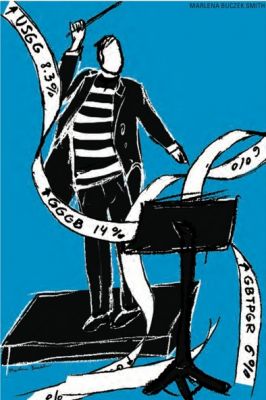
Pleasing the markets means pleasing the credit rating agencies — Standard & Poor’s, Moody’s and Fitch — an example of cult-like devotion in which the elite command us to drink the Kool-Aid. Like a death watch, the media turn anxiously to the rating agencies to ask the condition of U.S. government debt. Are they going to downgrade it, which would mean higher interest rates and an even bigger debt problem? This is another lie as Japan’s huge debt — more than twice the size of U.S. debt as a percentage of GDP — was downgraded in January and “there was no negative impact at all,” according to one analyst.
Let’s review how the big three credit rating agencies inflated the mortgage bubble. The bubble was driven by the banking industry’s insatiable appetite for debt, the repackaging of dicey mortgages into profitable securities. The agencies, especially Moody’s and S&P, gave investment-grade ratings to almost any sack of residential mortgage backed securities (RMBS) and collateralized debt obligations (CDO) that landed on their desks. By law, banks, pension funds, insurance companies and other institutional investors need investment-grade ratings on these securities to hold them. Since the rating agencies were paid by the issuers, they were raking in cash by gold-plating shit. Moody’s revenue on these securities quadrupled from over $61 million in 2002 to over $260 million by 2006. For S&P, it went from $64 million to $265 million for CDOs in the same four years and from $184 million in 2002 to $561 million in 2007 for RMBSs.
Don’t think they didn’t know exactly what they were doing. At S&P, one manager emailed a co-worker in December 2006, “Let’s hope we are all retired and wealthy before this house of cards falters.” Then, according to a U.S. Senate report, the ratings firm triggered the financial collapse by downgrading huge amounts of these securities from AAA to junk. In one day, on Jan. 30, 2008, S&P downgraded an astonishing 6,300 ratings. In 18 months the two firms downgraded more securities than they had done in their entire 90-year histories. Once the securities turned to junk, the big players could no longer hold them, which burst the bubble as they were sold in a panic and losses began mounting on the bank’s balance sheets.
We know the rest of the story – the financial collapse, the trillions in bailouts and credit lines, the lack of punishment for executives at any of these firms, the return to obscene profits a year later, the de-fanging of any credible reform. But now, we are being told, the rating agencies word on debt is the word of God.
This time, S&P is not so much looking for a fast buck as nakedly pushing an agenda. On July 14, S&P issued a detailed statement, explaining that it was placing both long-term and short-term U.S. debt “on CreditWatch with negative implications.” It explained that “there is an increasing risk of a substantial policy stalemate enduring beyond any near-term agreement to raise the debt ceiling.”
S&P did offer a safe passage. If it determined that if “an agreement would be enacted and maintained throughout the decade” to realize “budget savings of $4 trillion,” then “other things unchanged” it could affirm the stellar ratings on both short- and long-term U.S. debt. But, it warned, any “credible” agreement “would require support from leaders of both political parties.”
S&P is telling Capitol Hill to drive a stake through the heart of the welfare state. To let the peasants know they must till the corporate fields until they die. Otherwise, the credit rating deities will rain downgrades upon our heads, blighting the land for future generations.
We must pay now and forever. This is the truth of the matter, a truth so crude it seems comical. Which is why we need so many lies.






 Arun K. Gupta