
September 19, 2012
Laura Flanders talks to Arun Gupta and Marina Sitrin about Occupy’s impact and future role in American life and politics at the first anniversary of the movement on Bill Moyers.com.

September 19, 2012
Laura Flanders talks to Arun Gupta and Marina Sitrin about Occupy’s impact and future role in American life and politics at the first anniversary of the movement on Bill Moyers.com.
Filed under Occupy Movement

At the top of the list of what the Occupy movement accomplished is, “We surprised ourselves.”
By “we,” I mean anyone residing on the left. To be on the left is to be intimate with defeat. Sometimes defeat is heroic, as with the Spanish Civil War. Sometimes it’s betrayal, as with the fate of the Russian Revolution. Defeat can be bewildering, as in, “What happened to that moment of Feb. 15, 2003?” Often it’s just depressing, like the delirious 60s that gave way to the tortuous 80s.
Occupy, in contrast, was a rocket ship of giddiness for nearly two months. Liberals squirmed, reluctant to criticize or embrace it. Conservatives yelled from rocking chairs that the dirty hippies needed a job. Every police attack gave Occupy strength. A bewildered media tried to grasp how a leaderless movement could shake the halls of power.
It helped that there were no expectations for success. There were no pollsters tut-tutting that the 99% versus 1% was divisive. No professional organizers corralling the herd into a single message. No revolutionaries hectoring that only the scientific terms proletariat and bourgeoisie would do. No Democrats demanding that lofty aspirations be pulverized into middle-of-the-road mush.
Occupy rejected all the rules and injected its own style of class politics into the body politic. Much of the center clambered aboard the 99% train. They got the idea because they had been getting the shaft.
Soon it was Occupy everything – the banks, the homes, the hood, the workplace, universities, cinema, food, healthcare, gender, music, philosophy. Nothing, even abstractions, seemed out of our reach to recreate after checking centuries of capitalist baggage at the door. Iconic images and deeds piled up: Shamar Thomas facing down a phalanx of cops, armed with nothing but fatigues and lungs; a pepper-sprayed but defiant Dorli Rainey; the silhouette of occupiers triumphant at the shut-down Port of Oakland.
The small things made the biggest difference. Occupy changed how we felt. We were the motor of history, not just its victims. The mic check gave us a participatory society, not just one of spectacle. We could have communities where food, shelter and care were available to all comers. We had a platform to share individual grievances and hopes and find unity. The homeless had names and stories. Lost souls found a purpose. The dispossessed were abundant in human kindness and connections.
Now, we know how the story developed. As much as the police repression smashed occupations and the mainstream media returned to snarky indifference, the Occupy movement fell into bad habits. Occupy made us want to be better selves, but pettiness, paranoia and selfishness stewed beneath. Donated money and equipment was stolen. Fights broke out over control of Facebook and Twitter accounts. Shady outsiders set up a national convention unaccountable to the movement. One power-hungry individual tried to grab all the money flooding into the Occupied Wall Street Journal by seizing control of the Kickstarter campaign. One labor organizer in Los Angeles attempted but failed to hijack the entire movement there by setting up a rival occupation. Liberals succeeded in co-opting Occupy through their branded “99% movement.”
At this point, many wistfully recall the heady days of Occupy’s youth, while wrestling with the cynicism of a premature old age. We comfort ourselves with taxonomic analyses, naming every social movement that has evolved from Occupy: a changed national debate; a move-your-money campaign from banks to credit unions; a slew of new and old media projects; a robust home-foreclosure defense movement; a grassroots uprising against coal, natural gas and oil extraction; labor solidarity from coast to coast; a debt strike. Or we describe the anatomy of the movement: the slogan of “We are the 99%” that gave us a voice; the target of Wall Street that gave us a reason to be; the tactic of mic check that gave us a body; the strategy of occupation that gave us the people.
But none of this captures the heart and soul of Occupy. The sensation of surprising ourselves. That we could overcome juvenile bickering. That we could master history. That we could speak to, and not just of, the people. That we could let secret fantasies tumble from minds to mouths to a circle of people that breathed life into them and gave us a glimpse of a future we thought we would never see.
It would be easy to let acid disappointments etch away memories of dreams made real. But they were real if fleeting. And holding fast to the importance of that experience can propel us to new heights still.
Filed under Occupy Movement
Please support our latest project: Occupy the Film Festival!


In celebration of the first anniversary of the movement that ignited the public imagination around the world, Occupy the Film Festival will be held at the premier independent cinema in downtown New York City, Anthology Film Archives, 32 Second Avenue at 2nd Street in New York City, this Saturday September 15 at 6 pm and 8:30 pm and Sunday September 16 at 7:30 pm. The festival will feature a curated collection of outstanding films about the movement, including U.S. and New York City feature premieres, exclusive filmmaker Q+A sessions, outdoor guerrilla projections by the Illuminator van, an Occupy photography show by award-winning photographers, Occuprint collective poster display, Occupied newspaper exhibit from around the country and informational tabling. See films from Canada, Greece, Spain and Hawaii! Hear from the home foreclosure defense and student debt movements! Organized by a collective of independent filmmakers, artists, journalists, activists and academics, in partnership with Haymarket Books, Deep Dish TV, Cinema Libre Studio, Paper Tiger TV, People’s Production House, Global Action Project, Media Action Grassroots Network, and Queers for Economic Justice, Occupy the Film Festival tells the story of the first inspiring year of the movement through art with depth, compassion and humor. Please buy tickets today and support this all-volunteer effort to bring art by, for and to the 99%. Tickets are on sale now at occupythefilmfestival.com.
Filed under Occupy Movement

It was not what I expected to hear from a politician. I had invited myself to the Congressional Black Caucus party – sponsored by Duke Energy – at the Democratic National Convention. An African-American elected official and Obama delegate was venting about racism in Oklahoma, when he confided: “Listen, I probably should be saying this, but if Barack Obama wins a second term it will be bad for blacks in Oklahoma.” I looked at him quizzically. “The board room,” he explained. “There’ll be retaliation.”
He added that he encouraged young African-Americans to leave Oklahoma because there was little economic opportunity in a state dominated by “racist rednecks.” At the carefully scripted convention, his message was a screeching reminder that no amount of soaring oratory could mask the painful reality of economic decline and thriving racism.
Now, it was hard not to be moved by the beautiful African-American First Family on stage in Charlotte the final night. The symbolism of a nation progressing from slaves on plantations to the Obamas in the White House is powerful. It’s even more potent coming after years of “Obama is a Kenyan-born Nazi-Muslim-Socialist” oozing from every orifice of the right and the GOP’s presidential nominee slinging a birther joke.
That symbolism, which has lost its luster after four bleak years, had a bit part in Charlotte that went largely unnoticed. Around the DNC were scores, perhaps hundreds of vendors, peddling memorabilia of Obama and the First Family such as tee shirts, buttons, hats, posters, calendars, books, and programs.
The vendors were overwhelmingly African-American. I conversed with six of them. Most looked to be middle aged and worn out. Two were from Charlotte; others travelled from Florida, Atlanta and elsewhere in North Carolina. “Business is okay” was the standard response when I asked if they were making money.
John, a warehouse worker from Winston-Salem, hawked buttons and programs in downtown Charlotte. He said a friend who had a company making buttons hired him and 14 other vendors on commission. “They count out the buttons. We sell ’em for $5 each, and get $2 for each button. If you don’t sell anything, you don’t make any money.”
A block away, Cynthia, a slight woman from Jacksonville, Florida, struggled with a board of buttons. “Proceeds go to a local food pantry.” Upon further questioning she said she received $2 a button. She was hired after responding to a Craigslist ad, driven to the convention from Jacksonville and given a room in Charlotte. “I have to pay for my own food though,” she added, juggling a box of Bojangle’s “Famous Chicken ‘n Biscuits” along with the buttons.
Cynthia looked like she was 60 and missing most of her teeth. I asked how she was doing. “My back hurts, but I’m used to it,” she shrugged. She took time off from her job in Jacksonville as a healthcare aide. “Most of my patients are 300 pounds and I have to move them. I’m 114 pounds. We have techniques to do it,” she added with a grin.
The dirty secret about the 21st-century economy you won’t hear from either party is that millions of jobs involve moving goods or tending to bodies. More than 3.3 million Americans currently earn an average of $10.85 an hour moving goods by hand. Another 1.9 million pocket $9.70 an hour as personal care and home health aides. With a hollowed-out manufacturing sector, Obama’s promises aside, and an aging population, employment is growing in these fields. When you add in related fields, such as truck drivers and construction helpers or child-care workers and medical assistants, the ranks of these low-wage workers swell to more than 13 million. It’s hard not to notice that the workers are disproportionately African-American (and Latino).
The painful irony of Obama is that even as he represents the potential of triumphing over racism, the reality for most of Black America is an apartheid-like economy. Every indicator screams depression. A real unemployment rate of23 percent for Blacks. A childhood poverty rate of 33 percent. A foreclosure rate 47 percent higher than white Americans. Since 2005, the wealth of Black families has been razed by more than 50 percent to $5,700 per average –one-twentieth the amount of white families. For Hispanics, the story if virtually the same.
Abandoned by a society in which no banker is left behind – by 2011 the feds instituted 76 separate programs and measures with potential support topping $15 trillion – those at the bottom are lectured by Obama that “we insist on personal responsibility,” “hard work will pay off,” and “not every problem can be remedied with another government program.”
Once the glittery words are dusted off, Obama and the Democrats are peddling trickle-down economics. They will “reward” companies that “create new jobs here.” They will sign new trade agreements. But remember, “We don’t want handouts for people who refuse to help themselves.” The talk about education and jobs has been the mantra for decades. The difference is now Democrats have jumped on the beat-up-public-education bandwagon even as we train workers for jobs that don’t exist.
When Obama spoke about personal responsibility and celebrating “individual initiative,” he was not talking about people like Cynthia and John. They work some of the hardest jobs in our society for the lowest pay, and still muster the energy to work some more. They practice raw capitalism, making their living one tee shirt and one button at a time with no safety net.
It’s not that there isn’t a difference between the two parties. To the Democrats’ warmed-over Reaganism, the Republicans propose bare-knuckled plutocracy. It’s a choice between more of the same and a descent into darkness. But for Cynthia and John and Black America, a new day is still far over the horizon no matter who wins.
Filed under Democratic National Convention, Economy, Race
Protests in Tampa and Charlotte have been swarmed by police and enveloped in surveillance.
AlterNet / By Arun Gupta / September 6, 2012
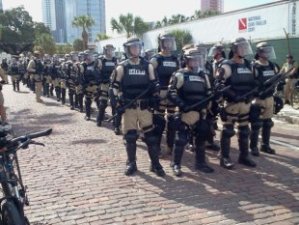
During the Republication National Convention in Tampa, nearly 100 police in body armor and riot gear swarmed in after a large group of anarchists confronted a handful of right-wing protesters from the Westboro Baptist church.
Photo Credit: Arun Gupta
CHARLOTTE, N.C. — In cities hosting large gatherings such as the national political conventions or international summits, we’ve come to expect a massive militarized police presence, even as the ranks of protesters thin. But what happens to all of the new high-tech cop toys and newly passed ordinances once conventioneers leave town? They stay.
I was at the alternative journalist flophouse in Charlotte on Sept. 4, the first day of the Democratic National Convention, when I received word of kettled protesters a few blocks away. I had just met FireDogLake reporter Kevin Gosztola, and after forming a mutual admiration society, we raced outside.
We hoofed past siren-flashing police cars blocking side streets, hiking alongside an empty roadway. Walls of blue loomed ahead. Our hands went to our sides and drew cameras. As we neared a broad intersection, protesters appeared behind a double line of police using bicycles as barricades. The entire intersection was encircled by hundreds of ground troops, motorcycle cops, commanders, surveillance units and vehicles. Media flitted along the perimeter and uncertainty coursed through observers. Why had hundreds of police barricaded the protesters, were they going to sweep them up, would violence break out?
In turned out the protesters were conducting an impromptu street blockade, preventing delegate buses from proceeding on their appointed route. The police moved to funnel the protesters into an isolated grass field lined with metal fencing, the “free-speech prison.” It was devoid of life, save for CODEPINK’s Medea Benjamin on a loudspeaker demanding: “Free Bradley Manning” and “We don’t want a war with Iran.” A dozen anarchists approached the cage and broke into the “Hokey Pokey,” sticking their left arms in and singing, “You do the hokey-pokey and kiss your rights goodbye, that’s what it’s all about.”
It was a replay of the final night in Tampa, Fla., at the Republican National Convention. There, perhaps 150 protesters also blocked an intersection, delaying delegates exiting the convention after Mitt Romney’s acceptance speech. Nearly 400 police penned in the protest, and at every intersection visible, up to two blocks away, squads of police waited in reserve. A crew of seven Guardian Angels had deputized themselves as back-ups in case the police were overwhelmed, their tee shirts and bodies having seen better days.
Police-to-Protester Radio Incalculably Wide
Protests in Tampa and Charlotte have been surrounded by media, swarmed by police and enveloped in surveillance. Perhaps because of the military-like mobilization, arrests have been rare and police in both cities have not prevented unpermitted marches, though they have been tightly managed. There were only two reported arrests in Tampa, and activists who dropped banners and locked down at a coal-fired power plant were not arrested.
On Tuesday, Sept. 4, ten undocumented immigrants were hauled off after staging a nonviolent civil disobedience action. Police also nabbed three protesters, including one for wearing a mask and another for allegedly crossing a police line – something I did multiple times without incident. Of course, I was wearing a suit, and the protesters were a bit scruffier, lending weight to activists’ contention that police single them out based on their appearance.
I moved on to a Planned Parenthood rally taking place nearby. I talked my way through the first layer of Secret Service despite lacking credentials. The crowd was a pink haze of tee shirts bearing the slogan, “2012 Yes We Plan,” with the zero replaced by a circular package of birth-control pills. With the branded tees, pink signs declaring “Women are watching and we’re voting Obama,” and canned speeches for Obama, it had all the spontaneity of a corporate rock concert, as soothing to the Democratic Party machine as a river of pink Pepto-Bismol. Unlike the feral anarchists outside, the pro-choice troops inside the Democratic fold were free of a suffocating police presence.
Drones, “less-lethal” weapons and anti-dissent laws
The feds gave $50 million each to Tampa and Charlotte for security for the conventions, and it showed in the police mobilization and shiny new equipment ranging from bicycles and “less lethal weapons” to communications gear and medieval-style armor for cops and horses. Given the fact that protesters amounted only to a few hundred, it’s suspicious that thousands of police needed to be deployed — more than were in evidence for massive protests in Washington, D.C. against the Iraq War a decade ago.
The biggest impact of militarized policing is not at the conventions themselves, but in the long term. The two political conventions coincide with the Summer Olympics. The international games proved to be a handy way to push out the poor from city centers by constructing stadiums and Olympic villages that are repurposed for tourism, consumption and high-end housing. Similarly, conventions and summits like NATO, G8, the RNC and DNC are part of the trend of intensifying the policing of poor and dissidents.
In some cases the convention policing leads to a more aggressive posture. In Denver, which hosted the 2008 DNC, 200 police in riot gear used their toys on Occupy Denver last October, attacking them with rubber pellets, mace, batons and pepper spray. In Chicago, new laws passed to stifle dissent at NATO protests there in May were made permanent, as were laws passed in Charlotte for the DNC. (The Tampa laws had a sunset clause.)
The covert side of policing summits and conventions is more disturbing. Tactics like infiltration, spying and provocateurs sometimes come to light when raids of activist spaces, pre-emptive arrests and contrived terrorist plots are sprung and the victims snared. Other elements remain covert.
Speculation was rife if drones would be employed during the RNC. A Tampa police spokeswoman denied that any of the “60 local, state or federal agencies involved in the security operation of the Republican National Convention will utilize air or ground drones.” But a private company, United Drones, was adamant that it would be flying drones for an unnamed private party during the convention. The morning after the RNC ended, as I drove into Tampa across the Howard Frankland Bridge with a legal observer, we spotted a low-flying aircraft. It looked like a large model aircraft with no obvious cockpit to hold a pilot, but was moving much faster than highway traffic.
Militarized and pre-emptive policing
Alex S. Vitale, associate professor in sociology at Brooklyn College and author of City of Disorder and numerous reports on protest policing, told AlterNet that he pinpoints the “intense changes” in policing to the 1999 World Trade Organization Ministerial in Seattle that was disrupted by nonviolent protests. (The much-reported window-breaking by self-described anarchists took place after and away from the much larger nonviolent actions.) But there is no across-the-board standard, he cautions. “Policing is more militarized or pre-emptive in depending on the department,” he says.
“[P]olicing in the U.S. is very decentralized,” Vitale explains, and “the handling of protests is left to the local police.” At the 2000 RNC in Philadelphia, says Vitale, there was a “heavy police response, pre-emptive arrests, mass arrests, holding people on exorbitant bail.”
In New York at the 2004 RNC, the police response was “pre-emptive,” as Vitale describes it, complete with “mass arrests, infiltration and surveillance.” In 2000 at the DNC in Los Angeles, the ACLU lambasted the LAPD for creating “an orchestrated police riot” after shooting tear gas and rubber bullets into a crowd at a rally for which organizers held a permit. Vitale says there was a “more militarized response” at the 2008 RNC in St. Paul.
Thus, the decision to give protests some breathing room in Tampa and Charlotte is notable because of past convention experiences, as well as the police attacks on Occupy camps in the last year. That may explain the absence of outright police aggression. Given the highly scripted nature of the conventions, 16,000 journalists looking for a story, and the prominence of Occupy Wall Street, chaos on the streets could have bumped the canned convention speeches from the top headline.
Vitale says: “Local officials want to minimize the level of dissent because to them, it’s all a very high-risk endeavor. They don’t want to get caught with the protests interrupting the events in any way.”
The danger of speaking out: ‘Jesus, it’s a war zone.’
I mention to Vitale that the Occupy Movement succeeded in part because it was theater: People acted out a new society in public. The flip side was the theater of the police response — from the military-style assault on Occupy Oakland to the stormtrooper gear of Portland’s police to the cinematic staging of thousands of New York police sealing the financial district the night of May Day.
Vitale agrees there is an element of spectacle. He says the militarization of policing “communicates a symbolic message to participants and public that speaking out is dangerous and must be treated as a violent threat. The use of body armor and vehicles is almost never warranted. It communicates a message of fear and violence.”
That spectacle was on full display in Tampa and Charlotte. The day after Hurricane Isaac swiped Tampa, I wandered through the security zone, perhaps a quarter mile around the convention’s outer security perimeter. Stopping at a Salvation Army truck for some cold water, the only other civilian was a sun-crisped local. Appearing dazed, he gestured to the empty streets, speaking to no one in particular, “It’s a military zone. Jesus. It’s a war zone.”
Squads of camouflage-clad cops marched by; pelotons of bicycle police cruised streets; posses of horse-mounted police stood at the ready; heavy-duty golf carts crammed with law-enforcement personnel zipped by; platoons of riot police shadowed protesters; two-man teams on overpasses scanned areas below with binoculars, Secret Service in bulletproof vests secured checkpoints; assault boats plied the water; choppers circled above.
While there is federal involvement in policing conventions says Vitale, “I’ve always resisted the notion that we can explain the intensification of policing as a result of federal intervention. The military, fed law enforcement and local law enforcement have all become less tolerant of dissent. They are all experimenting with new techniques and technologies to aggressively contain the dissent. They are all learning from each other.”
Keeping away all but militants and fanatics: “making money off orange jumpsuits”
In the security state, democracy has withered. In Tampa during the Republican National Convention, what was known as the “free speech zone” was a portable stage on a crumbling road slicing through barren brownfields. The Westboro Baptist Church – the “God hates fags” gang that pickets the funerals of dead U.S. soldiers based on the logic that they were killed as divine retribution for believing “it’s OK to be gay” – entered the zone one afternoon. As a handful toted flamboyant posters of hate, more than 100 police took up position.
A minute after I chanced upon them, a hundred or so anarchists marched on the scene chanting, “We’re here, we’re queer, we’re anarchists, we’re going to fuck you up!” Dozens of reporters and cameraman stalked the edges like lions hunting antelopes. As the protesters encircled the Westboro crew, mixing insults with pleas for tolerance, 100 riot police pounded the street as they rounded the corner. More police poured in from every direction and a helicopter swooped in.
Despite the tension, no violence occurred. Vermin Supreme, the performance activist who sports an upside-down boot affixed to his head, gently dissuaded the police from breaking heads by pointing out over a bullhorn that there was no need for aggression against peaceful protests. The anarchists had made their point and went on their way. But the city of Tampa had also made its point. In the militarized convention space, the only groups exercising the right to dissent are left-wing militants and right-wing fanatics.
There is a strategy to this. Vitale says, “We are producing urban spaces in many cities that are hostile to dissent. The summits accentuate that by adding in a layer of barricades and intensive policing.” The purpose of the intensive policing, he argues, is to insulate the rich and powerful who attend the conventions “from the rabble.” He adds: “Dictators have been doing this sort of thing for generations.”
I asked Vitale if these conventions are pop-up police states. He countered, “I’ve been to police states, and you get shot if you demonstrate, not spend a night in jail.”
That’s true — for most Americans. But at a rally against voter suppression in Tampa, Life Malcolm, a member of the Black People’s Advancement and Defense Organization, described his hometown.
“Tampa is a police state,” Malcolm said. “Twenty four hours a day, seven days a week we are under constant surveillance. We see the police on every street corner, in their cars, on their bicycles, or on foot patrol in our communities. All night long their helicopters are whirling overhead when we are trying to read with our children, put them bed or be romantic with our mates. The police beat us up, scare us, lock us up, harass us. You can’t even walk down the street being black, drive down the street being black.”
As a consequence, said Malcolm, “In our neighborhoods nobody comes outside. Everybody is boarded up in the house because they are afraid to come outside the house and be caught by the police like some kind of animal. In the state of Florida, they used to make their money off oranges, now they make their money off people in orange jumpsuits.”
Long after the media and politicians are gone, dozens of local and state police agencies will be back at work, showered with new weapons, technology and laws to contain troublemakers and undesirables. No matter who wins in November, the march toward a police state will continue unabated.
Filed under Democratic National Convention

I put on my best right-wing drag for Michele Bachmann. She was going to introduce the late Andrew Breitbart’s “Occupy Unmasked” documentary at the Citizens United tent in Tampa. I was eager to ask her about the grave issues afflicting America.
Having taken a seat in the air-conditioned tent, after enjoying chicken sliders and BBQ pork courtesy of Breitbart, which led one reporter to wonder if we were being served his Eucharist, I missed Bachmann’s entrance. But there she was, fresh and zealous-eyed in an ivory jacket and skirt and purple lei. She nimbly pressed the flesh, drinking in the affection.
I nudged into her bubble and Travis, a “local, conservative lawyer,” kindly snapped a photo of our encounter. I was cleaned up, with a new outfit, Mitt Romney 2012 button and Citizens United Production press pass. “Rep. Bachmann, I respect everything you do,” I told her. “Oh, thank you,” she replied, her smile broadening, warmly pressing my hand.
She had moved on before my question tumbled out: “What can we do about the epidemic of pornography and masturbation in America?”
She turned, flashing a curdled face, but soldiered on. I didn’t get a chance to ask my follow-up, “Does life begin at ejaculation?”
My mission for the Republican National Convention was to chat up the right. Having attended Tea Party meetings, I knew I would scare off the faithful if they suspected I wrote for outlets such as Truthout and AlterNet. So, posing as a fellow red-state American or right-wing blogger, I managed to converse with a few of the ground troops and soak up some agit-prop.
Properly outfitted and with the right mindset, it’s not hard to draw out the toxin that lies beneath. Roger, an elderly RNC volunteer in the Citizens United tent, said, “If Obama loses and he’s going to lose, there’s gonna be violence.”
The right is obsessed with race war. “Occupy Unmasked” warned race war was on the left’s agenda, that and revolution, sex, drugs, violence and pooping in public.
Travis was more measured. He wants Romney and Ryan to “be real leaders. Rein in federal spending. Let the private sector run free, create more jobs, return prosperity to America.” At the top of his agenda was “repeal Obamacare. Rein in entitlement programs. Eventually privatize them. We need to get rid of departments that don’t do anything.”
Loosening up, Travis unfurled his Tea Party flag. “Mitt Romney loves America. Barack Obama was raised to change America. I heard on the radio that he didn’t celebrate July Fourth growing up. His mother raised him to worship his father who was a Communist.”
As Travis held forth, his colleague Jonathan stood by and smiled. I inquired about voting fraud in Florida. Neither thought illegal voting at the polls was an issue, but with a guffaw they agreed that Democrats stole elections. Travis said, “I just can’t see conservatives who love America commit voter fraud.” On a roll, he pressed the gas. “It’s Democrats and ACORN signing up dead people. And we know where ACORN comes from: community organizer Barack Hussein Obama.”
It’s not hard to find outlandish tales here. What’s more striking about the right is how cliché it is, down to the parade of Chino and Oxfords, fake pearls and peroxide blonds that have invaded Tampa. Its message is just as bland, but that makes it all the more dangerous. Everyone is on message: reduce entitlements and privatize what remains. Cut “useless” departments like labor and education.
Tom McClusky, senior vice president of Family Research Council Action, said social spending needs to be “greatly reduced” because “a lot of the nation is getting federal assistance that doesn’t need it.”
It’s regurgitated Reaganism. Travis envisioned a capitalist Shangri-La if “government would just get out of the way. Revenue would go up if we lowered taxes.” I didn’t mention supply-side economics has been the orthodoxy for more than 30 years, and Obama probably slashed more taxes in one term that Bush Junior did in two terms. The difference is Bush showered the gold upon the rich, so it boosted the economy less than Obama’s cuts, particularly the (short-sighted) payroll holiday.
The right is close enough to power to feel social programs writhing on the chopping block like unemployment and food stamps, which amounts to a much-needed, but miserly, $134 a month for the 44 million Americans who received it last year. No one with an ounce of reason believes eliminating these programs will do anything to reduce the deficits. As the poor are disproportionately Latino and African-American, it’s really an attack on these communities.
When the legions of the RNC say prosperity, they mean for “true” Americans. The Tea Party cries, “We the people” and “Take back America.” It is a white revolt against the dark, grasping hordes. Only fanatics claim that the Republican National Convention’s diversity that’s reminiscent of a 1950s country club is unrelated to leaders who cackle about suppressing the black and Latino vote and voters who more readily believe Obama is Muslim instead of Christian.
Hypnotized by a self-serving ideology, the right happily swallows a contradictory formulation like America will cut its deficit and return to greatness by letting plutocrats raid the federal treasury while swiping food, medicine and education from workers.
The culture wars beloved by fanatics like Bachmann are the medieval icing on their voodoo economic cake. Their policies wreak real damage on women and gays and lesbians and Muslims. I got a preview of their utopia at Christine O’Donnell’s “Troublemaker Fest.”
The day after Isaac side-swiped Tampa, I pushed through the swampy aftermath to the Troublemaker Fest at the Imax Theater near the convention center. Overheated, I collapsed in an empty, chilly theater showing “Troublemaker,” the film. In the future, religious expression is frowned upon, schoolchildren are forced to stage “alien-origin winter pageants” and sinister pinky-ring-wearing secularists sweep into town banning public displays of Christmas and Cross. The defiant patriarchal hero wonders out loud, “Did you ever notice how the mere mention of Jesus seems to rub everyone the wrong way these days?”
I sat there, sickened from the heat and humidity, pondering how the Christian right would celebrate the providence in an atheist socialist perishing as he watched small-town determinism and faith triumph over wicked liberals and faceless bureaucracies.
The movie rebooted Reagan’s fantasies about America. White people give us back Christmas – which “is for everyone” – because our boys and girls are dying fighting in countries where “people are killed” for trying to celebrate the birthday of Jesus. Black people are obedient stepin-fetchits, Latinos are nonexistent and the twisty-wristed, turtle-necked director of the winter pageant is tricked into a locked closet with a sign that reads, “If you borrow something from the closest please return it.” (Really.)
After recovering in body, if not quite in mind, I trudged back through the security zone. Police were everywhere – platoons of armored cops, lines of bicycle cops, formations of cops on horses. Humvees and SUVs cruised by, patrol boats skimmed the harbor and helicopters buzzed above. Layers of checkpoints, fencing and concrete barricades chopped up deserted streets. One of the few civilians in the security zone was a sun-crisped local. “It’s a military zone. Jesus,” he said looking disoriented, “It’s a war zone.” No amount was spared to protect against chimerical threats of terrorism, but the military muscle is useless against the global warming that dare not be named.
If you believe democracy can be tucked inside a racially purified gated community and martial law imposed outside, then you’re willing to accept any wild fantasy as reality.
It’s not that those on the left side of the spectrum are immune to irrational beliefs – many liberals are in denial about Obama’s horrendous right-wing record and many leftists indulge 9/11 truther mythology.
But the right has a unique capacity for believing the unbelievable. It’s allowed politicians like Paul Ryan, Mitt Romney and Michele Bachmann, who would have made fine Neolithic shamans, to rise to positions where they can conduct their warped antediluvian experiments on an entire planet.
Copyright, Truthout. May not be reprinted without permission.
Filed under Republican National Convention

Politics is an elaborate chess match, and in St, Petersburg one small strike was staged against the Republican National convention on Aug. 26 that revealed the thrust of President Obama’s 2012 re-election strategy.
As panicky Republicans cancelled the first day of the convention on Monday because of Tropical Storm Isaac, the focus on Sunday was the “RNC Welcome Event” at Tropicana Field. These days no major convention event is complete without a counter-protest, and in downtown St. Petersburg nearly 500 people gathered Sunday to march to the sports stadium and voice their displeasure at what they derided as “the world’s largest cocktail party.”
Given the spitting rain and gusts, the turnout was better than expected. And given the months of police and press hype that a mob of mayhem-wreaking anarchists would crash the RNC, the protest rally around Mirror Lake seemed more like a festive Sunday in the park.
A couple of hundred people milled about as Dave Rovics belted out crowd pleasers like “I’m a Better Anarchist than You.” A handful of buses pulled up and disgorged more protesters who came from far away as Miami, New York city and Wisconsin. The rally and protest was organized by the Florida Consumer Action Network, a local grassroots organization focused on public policy issues.
Few anarchists were in evidence, apart from a scrum of fidgety black-clad youth who melted into the rally after drawing stares. It felt like an Occupy-related event with a giant puppet of Romney tagged with a “King of the 1%,” and chants of “We are the 99%.”
Grabbing attention with his preacher’s cadence, Rev. Manuel Sykes, president of the St. Petersburg NAACP, announced, “I’m here to stop the corporate takeover of America.” Sykes castigated “our leaders [who] want to privatize Social Security, Healthcare, Education and Prisons.” He blasted Mitt Romney for wanting “to enrich the 1%.” And he described the November presidential ballot in epic terms: “We’re not just fighting for the 2012 election. We’re fighting for the future of America as we know it.”
On the fringes off the rally, next to a pack of camouflage-clad sheriff’s deputies, a pungent, hippie-looking gentleman with a Ron Paul 2012 sign dangling around his neck and a video camera taped to his helmeted head, taunted the crowd. “Do any of these hippies here supporting Obama know that Obama has dropped two times as many bombs as Bush?”
His words stung one observer who yelled back that “Obama has to do the bidding of Washington.”
The exchange captured the conflicting mindset of the Democratic base. Romney, Ryan and the right are painted, not unfairly, as extremists who will hurtle America back to the dark ages. But Obama, despite sitting in the Oval Office, is seen as powerless.
The weather and fear mongering no doubt cut down on the turnout, but one community organizer clued me in to another factor. The organizer, who wished to remain anonymous, said “A lot of people I work with don’t have hope in national politics. There was an element of fear about the RNC, ‘Can I even go outside with all the street closures and restrictions?’ There is definitely animosity toward Republicans, a lot of ‘Fuck these guys,” but my members also questioned what was going to be accomplished by going out in front of the barricades. I heard a lot of ‘It’s not going to change nothing.’”
The anti-RNC event was labeled a “community vigil,” and it was strikingly diverse. There were anarchists, socialists, libertarians and unaffiliated radicals. Mostly it was white middle-class liberals, working-class African-Americans and a collage of poor people. There were numerous tee shirts and signs indicating support for Obama. What united the crowd was the 99% rhetoric.
That was by design. The community organizer said, “The word from on high was, ‘Don’t say working class, don’t say poor. Say middle class or 99%.’” Why 99%, I asked. “Because it polls well” the organizer explained.
The Occupy Wall Street movement lives on from student-debt campaigning and labor solidarity to home foreclosure defense and anti-fracking organizing. But as a national force Occupy has been reduced to a bogeyman police and politicians dangle in front of a lapdog media that dutifully report every outlandish allegation as stone-cold truth, and it exists as a mobilizing force for the Democratic Party.
You see, Obama is running a re-election campaign using Occupy Wall Street’s language. He won’t say the 99% or 1% outright. That would be too divisive, or so the media owned by the 1% say. But the attacks on Bain capital outsourcing and Romney’s secret tax returns are tapping into the volcano of anger that Occupy gave life to. Late last year an official in the AFL-CIO’s national office told me that Romney was their “dream candidate,” and in April Justin Ruben, executive director of MoveOn told me that Mitt Romney was “Mr. 1%.” Unions like SEIU and liberal groups such as MoveOn and Rebuild the Dream carry the water in flogging the message that Romney will be the president of the 1% who will turn the screws even harder on the rest of us.
That assessment is not untrue. The right would unleash a world of pain on most Americans. But the nature of our endless electoral process, which sucks all the oxygen out of the brain, blinds most Obama supporters to how the Democratic Party is complicit in pushing our politics to the right.
With close to one third of the population in or on the cusp of poverty, 46 million on food stamps, 51 million uninsured, a “real” unemployment rate stuck at 15 percent, millions of families doubled up and millions of homes still entering foreclosure, Obama can’t run on his economic record. Sure, much of the fault is the guy before him, but that excuse wears thin after four years. Particularly because Obama rode into office with a congressional super majority and a road paved with political capital.
But just as Clinton turned Reagan-era extremism into a bipartisan consensus, Obama doubled-down on the “war on terror,” and endorsed cutting Social Security and Medicare and enacting austerity policies within a year of taking office. Obama thus helped enable the next stage of right-wing extremism that he is now running against.
So it’s not really ironic that Obama has swiped the language of Occupy, even as his FBI and Homeland Security have made Occupy’s anarchists into Public Enemy #1. That’s how politics work.
Local organizers in Tampa know the deal. When I mentioned that liberal groups have co-opted Occupy by creating the 99% movement and are using the fury against the whole political system for partisan ends, two different activists agreed and went further. They said there was an astroturf element to the anti-RNC rally in St. Petersburg. One said of liberal groups and unions, “You see a lot of their tactics that amount to astroturfing. They see the Super PACs employ this strategy and they think they have to do the same thing. That’s what I find most troubling.”
The 99% are truly suffering. And it’s a no-brainer that they will suffer even more under Romney than under Obama. But under darkened skies sprinkling rain, no one at the rally spoke of brighter days ahead for the 99% if Obama does win.
Filed under Republican National Convention

 Arun K. Gupta